6 Emerging Technology Trends: The Future of Healthcare
Manisha
Jul 16, 2025
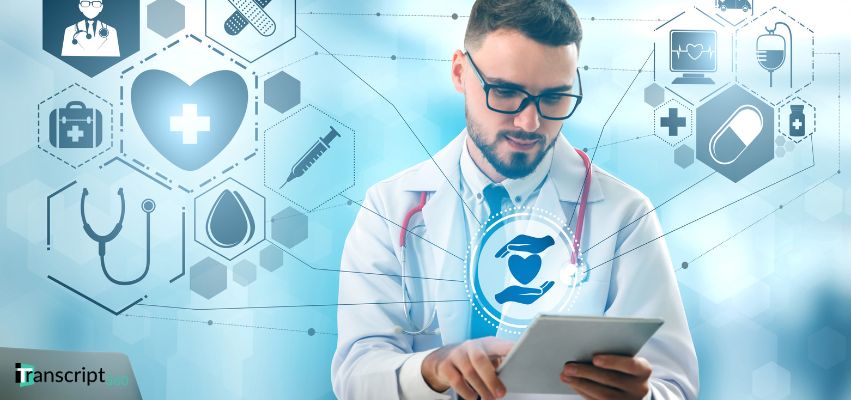
Ever wonder how healthcare is quietly transforming before our eyes? Cutting-edge technologies aren't just improving modern medical practices; they're fundamentally redefining patient care, operational efficiency, and even how we manage our own health. The improvements in medical transcription, a cornerstone of accurate patient records, provide compelling evidence of this shift. As medical transcription businesses, we see firsthand how new innovations allow us to transcribe physician dictations into text format, which puts the documentation into the electronic health record (EHR).
As 2024-25 continues its rapid pace, healthcare technology keeps improving. The effectiveness and quality of healthcare will undoubtedly continue to rise thanks to technology like artificial intelligence, machine learning, and extended reality.
Here are the Top 6 Trends in Healthcare Technology that are shaping tomorrow's medical landscape:
1. Remote Health Services: Bridging Distances in Care
Remember the early days of the global pandemic, when a simple doctor's visit felt like a risky adventure? The introduction of the global coronavirus that caused COVID-19 infections had a considerable impact on medical procedures and accelerated technological advancements in healthcare.
Many individuals understandably canceled their appointments to avoid waiting rooms with people who might be ill. They also avoided speaking with front desk workers, nurses, and doctors directly. Thus, the use of telehealth increased as a way to still permit clinicians to see patients, even if virtually.
Experts predict that telemedicine will be used more frequently than ever before. According to Healthcare Dive, the cost of medical services incorporating telehealth is projected to rise by 265% between 2020 and 2023, from $29 billion to $106 billion. This massive growth highlights how essential and convenient virtual care has become for patients and providers alike.
2. Monitoring Virtual Patients: Care Beyond Clinic Walls
Imagine attaching a heart monitor to a patient for an at-home study instead of keeping them in the hospital for several days. This is the growing reality of remote patient monitoring (RPM), a critical technological consideration for the future of healthcare delivery.
As the healthcare industry continues to rapidly change, digital health solutions like RPM will surely improve patient outcomes. Healthcare practitioners can easily monitor the vital data of their patients who are still at home from the convenience of their office, enabling earlier interventions and more personalized care without constant hospital visits.
3. The Power of Big Data: Unlocking Health Insights
The use of Big Data has significantly improved healthcare. It has completely transformed how huge amounts of raw data are analyzed to reveal hidden patterns. Big data has the potential to significantly reduce the cost of the patient's diagnostics and improve the patient's therapy.
Think about it: advanced Big Data mining and analysis tools may aid in the treatment of uncommon diseases using currently prescribed drugs and available therapies. The intricate processing of big data can lead to healthier populations by providing deep insights into a patient's earlier and present health data, predicting risks, and even personalizing treatment plans.
4. The Indispensable Role of AI in Healthcare:
It is no secret that artificial intelligence (AI) is currently reshaping a different industries, including healthcare. From automating administrative tasks to assisting in complex diagnoses, AI's presence is rapidly expanding. If a business needs to pre-qualify you for a loan or if your bank is low on human customer service representatives when you call, artificial intelligence might be deployed. In healthcare, its applications are far more profound.
Medical billing and revenue collection are already being accelerated by AI. These developments in healthcare technology are made feasible by artificial intelligence, which can quickly examine enormous amounts of unstructured patient data and create relevant connections for healthcare organizations.
According to Insider Intelligence, administrative tasks in a medical office can be handled by AI, including preauthorizing insurance and keeping patient information. Beyond the desk, AI is also able to track the specifics that humans would be unable to comprehend in real-time, using data from patient devices like glucose monitors and smartwatches. This capability leads to proactive care and early detection of health issues.
5. Medical Wearables: Your Personal Health Guardian
The Internet of Things (IoT) has had a huge impact on and improved the healthcare sector with inventions like wearable and even implant devices that monitor patient data in real-time. These devices often integrate with mobile apps for essential healthcare trending needs, allowing patients to actively track their health.
The value of health observations will considerably increase as more IoT devices become more widely available and affordable thanks to technological advancements. The health of individuals is improved by wearable IoT devices, which are now crucial to preventive healthcare. Customers can access insights into their daily activities to several months' worth of health trends with these wearable technology-powered devices.
As a result, their products have helped people proactively manage and track their health and maintain a healthy lifestyle. Thanks to the clever integration of smartphone apps and wearables, keeping track of daily health records and accurately diagnosing health trends in real-time have become convenient and user-friendly.
6. Securing the Digital Frontier: The Growing Cost of Healthcare Cybersecurity
As healthcare goes increasingly digital, so do the threats. Protecting sensitive patient records and medical systems is no longer just a necessity; it's a rapidly growing investment and an emerging trend in itself.
Installing monitoring systems, such as firewalls and anti-malware software, is necessary to protect systems that use software and healthcare technology. You might need to adjust your budget to accommodate increased security requirements.
The Health Insurance Portability and Accountability Act of 1996 (HIPAA) requires healthcare providers to keep patient records safe. It's realistic to anticipate that in 2023 and beyond, hostile hackers will relentlessly try to access and steal sensitive patient information. You might need to consult with computer security specialists to be sure you are taking the right precautions to secure your network and uphold patient privacy. The focus on cybersecurity is a critical trend driving innovation in secure data management.
Conclusion: A Healthier, More Connected Future
The healthcare industry is always looking for methods to increase productivity and improve patient outcomes. There is no doubt that computers and technology have generally changed medical transcribing. Reputable medical transcription businesses employ cutting-edge technology to provide accurate medical records, forming a crucial backbone for these advanced systems.
Medical institutions have been continuously adjusting and enhancing their healthcare trends to supply future specialists with high-quality care instruction and information. Since the pandemic, the tech industry has developed efficient, HIPAA-compliant procedures for in-depth, accurate examinations that take less time, elevating the trends in medical services.
The future of healthcare is bright, digitally empowered, and more patient-centric than ever before. As technology continues to evolve, so too will our capacity to deliver superior care and improve lives.